

“Geodynamic evolution of the Scotia Arc: the final breakup of Gondwanaland and its global implications” por Andrés Maldonado, Instituto Andaluz de Ciencias de la Tierra, Consejo Superior de Investigaciones Científicas, Universidad de Granada.
Resumo da conferência:
The Scotia Arc embraces southern South America, the Antarctic Peninsula, and the intervening part of the Southern Ocean including the South Georgia and South Orkney crustal blocks and the volcanically active South Sandwich Arc. It is a region of critical importance because of its role as a developing ocean gateway during Eocene-Miocene times, and because of its impact on global ocean circulation, with possible importance for Palaeogene-Neogene palaeoenvironmental change, early phases of development of Antarctic ice sheets, gene flow, and resulting biodiversity.
The opening of the Scotia Sea and of the Drake Passage located between South America and the Antarctic Peninsula is a subject of considerable controversy. Drake Passage is widely recognized as a key gateway that controlled Cenozoic water-mass circulation and climate in the southern hemisphere. The gateway permitted the gradual instauration of the Antarctic Circumpolar Current (ACC), which isolated Antarctica from the influx of warm currents from the north and intensified its glaciation. An initial interpretation attributed the climatic change and the development of the large Antarctic ice sheets to the opening of Drake Passage, although additional hypothesis attributed the Eocene/Oligocene climate change and the subsequent Cenozoic glaciation of Antarctica to variations in the concentrations of greenhouse gases.
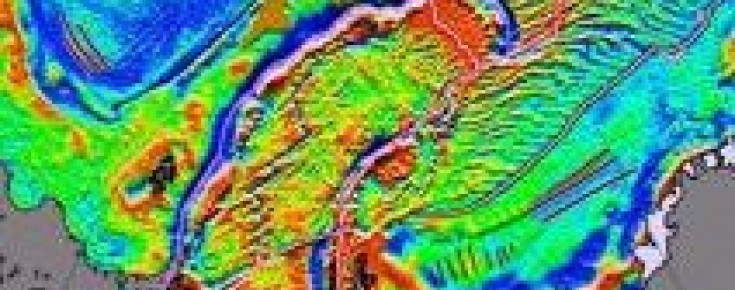
Evidence of oceanic crust formation in Drake Passage prior to the Oligocene, however, was lacking. The earliest evolutionary stages of the Drake Passage and the Scotia Sea, as well as the impact of that evolution on the global climate and development of Antarctic ice sheets will be analyzed in this presentation. A dense geophysical data set collected in the southwestern Scotia Sea is presented and evidences for the occurrence of oceanic crust that is older than previously reported are shown. The initial tectonic fragmentation of the South America-Antarctic Bridge, followed by oceanic spreading, was characterized by jumping of the spreading centers. An Eocene spreading center in the SW Scotia Sea was the precursor for the opening of the basin. A model with four tectonic evolutionary phases will be analyzed: Phase I, Pacific subduction –Paleocene to middle Eocene; Phase II, eastern Ona back-arc spreading – middle to late Eocene; Phase III, ridge jumping and western Ona back-arc spreading –early Oligocene; and Phase IV, ridge jumping and WSR spreading –early Oligocene to late Miocene.
The development of shallow gateways allowed an early connection between the Pacific and Atlantic oceans and, hence, initiated the thermal isolation of the Antarctic during the middle and late Eocene. Deep gateways that enhanced the full isolation of the Antarctica were developed in Drake Passage from the Eocene/Oligocene transition. A significant correlation is observed between the tectonics, stratigraphic units and major climate events, thereby indicating the influence of the local tectonic and paleoceanographic events of the southern oceans on the global evolution.
Organização:
Departamento de Geologia da FCUL e IDL - Instituto Dom Luís.
Como chegar ao C6 da FCUL?