

Como fazer a biodiversidade contar mais politicamente?
Por Humberto Rosa (Diretor para o Capital Natural - Direção‐Geral Ambiente, Comissão Europeia).
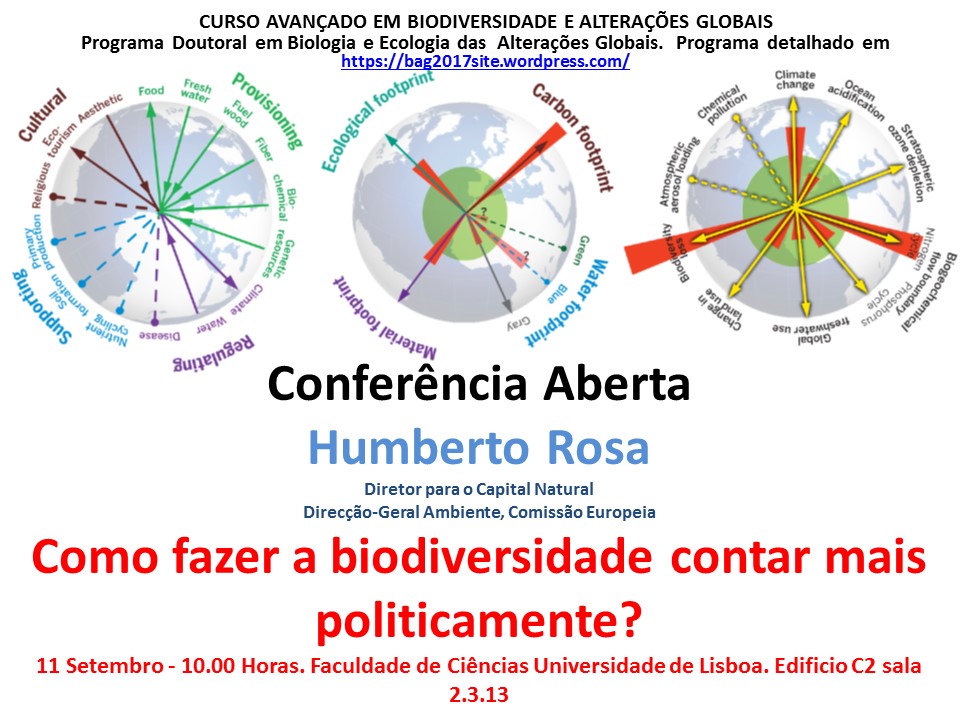
Por Humberto Rosa (Diretor para o Capital Natural - Direção‐Geral Ambiente, Comissão Europeia).
Uma iniciativa da Cascais Ambiente e da Câmara Municipal de Cascais, que serve de base para a apresentação do primeiro plano municipal de ação para a adaptação às alterações climáticas em Portugal.
Este inovador Plano de Ação, promovido pela Cascais Ambiente e elaborado em parceria com a Faculdade de Ciências da Universidade de Lisboa, consiste num ambicioso compromisso político que visa implementar até 2030, 13 medidas de adaptação que integram 80 ações.
Conferência final do projeto Green Surge, que conta com a participação do cE3c - Centro de Ecologia, Evolução e Alterações Ambientais.
The conference themes are related to emerging issues and future challenges of nature-based solutions and sustainable urban development.
Currently, climate changes or alterations are known to be reflected on the stable isotope ratios of Hydrogen, Nitrogen, Carbon, Oxygen and Sulphur present in atmospheric gas forms, fresh or ocean water, as well as in plants and animals and organic matter in the soil. Samples from those matrices can provide a record for such changes across a given length of time and / or space. Also, ecological and physiological processes often reflect on stable isotope ratios, again setting a record in plant, animal or other living tissues.
The continuous urban development associated with the growth of the world population has become one of the most important challenges of the present time. Today, cities accommodate more than 54% of the world's population, a proportion that is expected to increase to 70% by 2050. Trends in urbanization show that cities are becoming more complex and heterogeneous social-ecological systems with growing demand for natural resources mainly for infrastructure, housing, food, water, and energy.
A sessão irá refletir sobre as cidades do futuro, um tema recorrente nos media pela incerteza da sua evolução.
Por Vítor Paiva (MARE-UC).
Maria do Carmo Barreto
Assistant Professor (IERS Group)
Laurence Jones
Centre for Ecology and Hydrology Bangor, Environment Centre Wales, North Wales, UK
There is increasing evidence of the effects that excess nitrogen has on semi-natural ecosystems globally, affecting vegetation, soils and ecosystem processes. Although coastal systems can be highly dynamic and in some cases receive inputs of nitrogen from marine sources, sand dune ecosystems have also been shown to be sensitive to nitrogen.
Imagina que era possível experimentar um curso universitário antes de concorreres ao ensino superior.