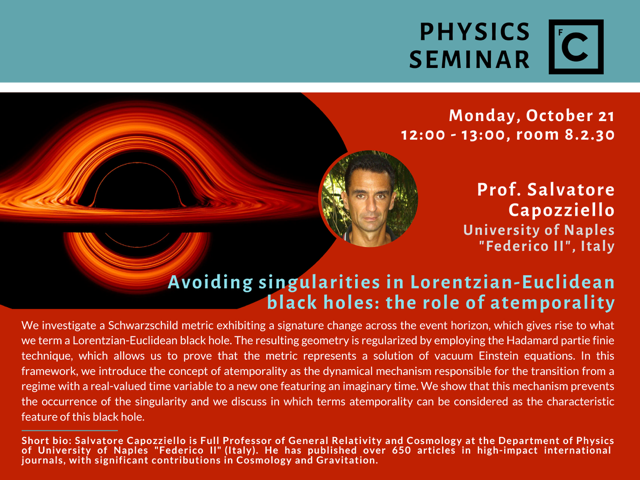


Por Salvatore Capozziello (University of Naples "Federico II", Italy).
We investigate a Schwarzschild metric exhibiting a signature change across the event horizon, which gives rise to what we term a Lorentzian-Euclidean black hole. The resulting geometry is regularized by employing the Hadamard partie finie technique, which allows us to prove that the metric represents a solution of vacuum Einstein equations. In this framework, we introduce the concept of atemporality as the dynamical mechanism responsible for the transition from a regime with a real-valued time variable to a new one featuring an imaginary time. We show that this mechanism prevents the occurrence of the singularity and we discuss in which terms atemporality can be considered as the characteristic feature of this black hole.
Short bio: Salvatore Capozziello is Full Professor of General Relativity and Cosmology at the Department of Physics of University of Naples "Federico II" (Italy). He is the Coordinator of the PhD program in Cosmology and Space Science at the Scuola Superiore Meridionale (Naples). From 2012 till 2020, he taught General Relativity at Gran Sasso Science Institute for Advanced Studies (L’Aquila). Since 2013, he is Honorary Professor at Tomsk State Pedagogical University (Russia). Since 2023, he is foreign fellow of the Serbian Academy of Nonlinear Sciences (Serbia). Since 2024, he is Corresponding National Fellow for the Class of Natural Science of the Academy of Physical and Mathematical Science of the Italian National Academy of Science, Literature and Arts (SNSLA). From 2012 till 2018, he has been President of the Italian Society for General Relativity and Gravitation (SIGRAV). His scientific activity is essentially devoted to General Relativity, Cosmology and Relativistic Astrophysics in their theoretical and phenomenological aspects. His main scientific achievement is related to the possibility to explain dark energy and dark matter as curvature (or other geometric) effects by extending General Relativity to more general classes of theories of gravity. Furthermore, he developed the so-called Noether Symmetry Approach to identify and solve dynamical systems representing cosmological models. A further field of interest is the astrophysics of compact objects (neutron stars and black holes) and gravitational waves with the aim to identify observational signatures for Modified Gravity. The results of these researches are published in almost 680 papers appeared in several refereed journals with more than 50000 citations. He is also author of monographic texts on General Relativity, Cosmology, Quantum Mechanics and Noether symmetries (Eds. Springer, Cambridge, Bibliopolis, Liguori). He has been supervisor of more than 50 PhD and 70 Master Italian and foreign students in Physics and Mathematics. He spent several periods of his scientific career in USA, Germany, Poland, UK, Russia, South Africa, Canada, Brazil and Japan.