Water management

Water management

Since 2013, Ciências ULisboa is actively promoting the increase in the efficiency of campus potable water use, for example, by identifying leaks in underground pipelines, in some cases installed at depths of more than three meters, and the making the progressive replacement of these pipelines by others installed at the surface, thus eliminating useless consumption and minimizing the likelihood of them occurring in the future.

Other measures include a progressive reduction in pressure in distribution circuits, the progressive replacement in toilets of end-of-life taps with taps equipped with sensors or a rationalisation of irrigation. As a result of this type of intervention, it has been possible to achieve, on average, a reduction in the use of potable water of about 3000m3/year.

portal-sustentabilidade-tabela-02-v2

Waste management

Waste Production Indicators

As a major producer of waste similar to Urban Solid Waste (USW), Ciências annually produces around 250 tons of unsorted waste and 130 tons of recyclable waste. Per capita, they correspond annually to approximately 40 kg of unsorted waste, 5 kg of paper, 3 kg of glass, 2 kg of packaging and 8 kg of organic waste, integrated in CML's collection circuits.

Ciências has been making an effort to recycle its recyclable waste, increasing and diversifying internal recovery circuits, through the establishment of protocols with licensed operators or, in the case of organic waste, through the development of composting processes (garden waste ) and vermicomposting (food waste).

The graph shows the evolution of the production of recyclable waste, forwarded through dedicated circuits to licensed operator, by type of waste, as well as the investment made by Ciências in increasing the number of recycling rows from 6 rows in 2015 to 16 in 2020.

In general terms, it appears that the amount of waste has increased over the years, which is due not to an overall increase in waste produced in Ciências, but to the increase in the fraction of waste that can be sent to licensed recycling operators and/or enhancement and for composting and vermicomposting processes.

indicadores-producao-residuos

Hazardous Waste

Ciências ULisboa takes an active role in preserving a healthy environment through the application of good environmental practices, the transfer of knowledge in this area and the awareness of employees, students and visitors. A correct waste management is, besides a legal imposition, an obligation of a Science School.

More information available at Resíduos (only in portuguese)

Typology

2015

2016

2017

2018

2019

2020

Hazardous liquid waste

1969

1619

2437

2982

10180

2596

Biological solid waste

2311

1682

2233

4865

4063

3575

Chemical/specific solid waste

461

607

413

1174

2043

3278

Annual production of hazardous waste, sent to licensed operator (values ​​in kg).

Results of the “Todos pelo IPO” campaign

From November 2022 to January 2023, on the campus of Campo Grande and in the East building of the Astronomical Observatory of Lisbon, in Tapada da Ajuda, we were able to collect and donate more than 5.5 tons of waste, including lamps, cartridges and toners, batteries and batteries and various electrical and electronic equipment.

Poorly deposited waste is a problem for the environment and human health. As they degrade, pollute the air, soils and waters with toxic components harming ecosystems and the health of all of us.


With this campaign, we contribute to the IPO mission and above all, we help protect the environment and give new life to our waste.

Dedicated recycling circuits

It has been possible to increase the recycling rate by placing outside ecopontos in strategic areas of the campus and also by placing small ecopontos inside buildings.

contentoresazuisandamarelos_0-medium

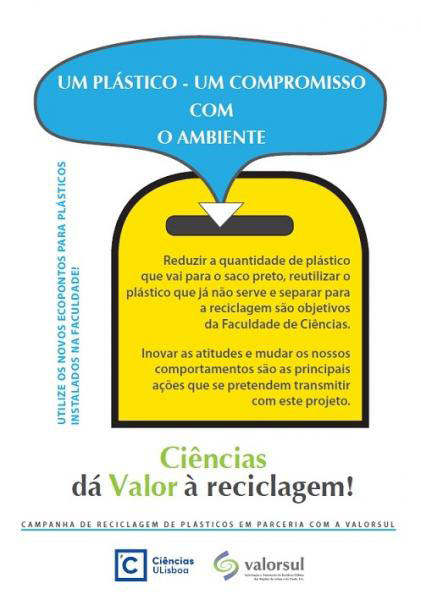
Ciências ULisboa values recycling

Plastic recycling campaign in partnership with Valorsul

campanha_plastico-medium

Blue Ecoponto - paper and cardboard 

  • Cardboard boxes, magazines and newspapers, writing and printing paper

  • Do not place plastic bags, polystyrene, dirty paper, silver paper, vegetable paper, paper with plastic, waxed paper, stickers 

Green Ecoponto - glass packaging

  • Bottles, jars

  • Do not place empty bottles of chemical reagents, dishes and ceramics, flat glass and glazing, crystals and mirrors, lamps

(Location: underneath the east bridge between the C1 and C8 buildings, and another in the C2 car park, opposite the Minicampus)

Yellow Ecoponto - plastic and metal packaging

  • Plastic packaging, beverage cartons, cans, plastic bags

  • Do not place empty packages of chemical reagents, paper and cardboard, household appliances

Ink cartridges and toners

Boxes for collecting used inkjet and toner cartridges in the following locations:

  • C1 Building – Near IT Services

  • C2 Building – 2nd Floor east, near women's toilet

  • C6 Building – 1st Floor in front of the administrative core

  • C8 Building – 6th Floor, near the DQB room 8.6.33

  • TecLabs Building – Floor 0, next to the stairs

Fluorescent and discharge lamps

Under the nascent bridge between the C1 and C8 buildings, there is a container from AMB3E for placing fluorescent and discharge lamps. If you also have lamps in your home that you want to dispose of, you can bring them and deposit them in the container.

Used oils

The Faculty periodically routes waste mineral waste oils (including pump oils). Users must deliver to the waste collection point outside the 1st floor of Building C1 on Thursdays between 10.45 am and 11.15 am.

Batteries and accumulators

Boxes for the collection of batteries and accumulators in the following locations:

  • C1 Building – 2nd floor, west atrium

  • C2 Building – 2nd floor, east atrium

  • C4 Building – G3S, room 4.1.26

  • C5 Building – 2nd floor, near the Surveillance Central

  • C8 Building – 2nd floor, administrative support

  • Tec Labs Building – Floor 0

  • MARE Building – Stairs between 1st floor and floor 0

Users can also request the collection of batteries and accumulators by e-mail.

Waste from electrical and electronic equipment

The Faculty periodically routes waste electrical and electronic equipment (WEEE). Users can request the collection of WEEE by e-mail.

Composting and vermicomposting

Annual compost production

Average values ​​for 2018, 2019 and 2020:

  • 28 tons of processed garden waste

  • 11.2 tons of fine compost produced


Annual vermicompost production

Average values ​​for 2018 and 2019 (2020 was not considered due to the closure of bars and restrictions associated with the COVID-19 pandemic):

  • 1.3 m3 of processed kitchen / bar waste

  • 0.9 tons of vermicompost produced

Announcements

Welcome to the new CIÊNCIAS ULisboa website