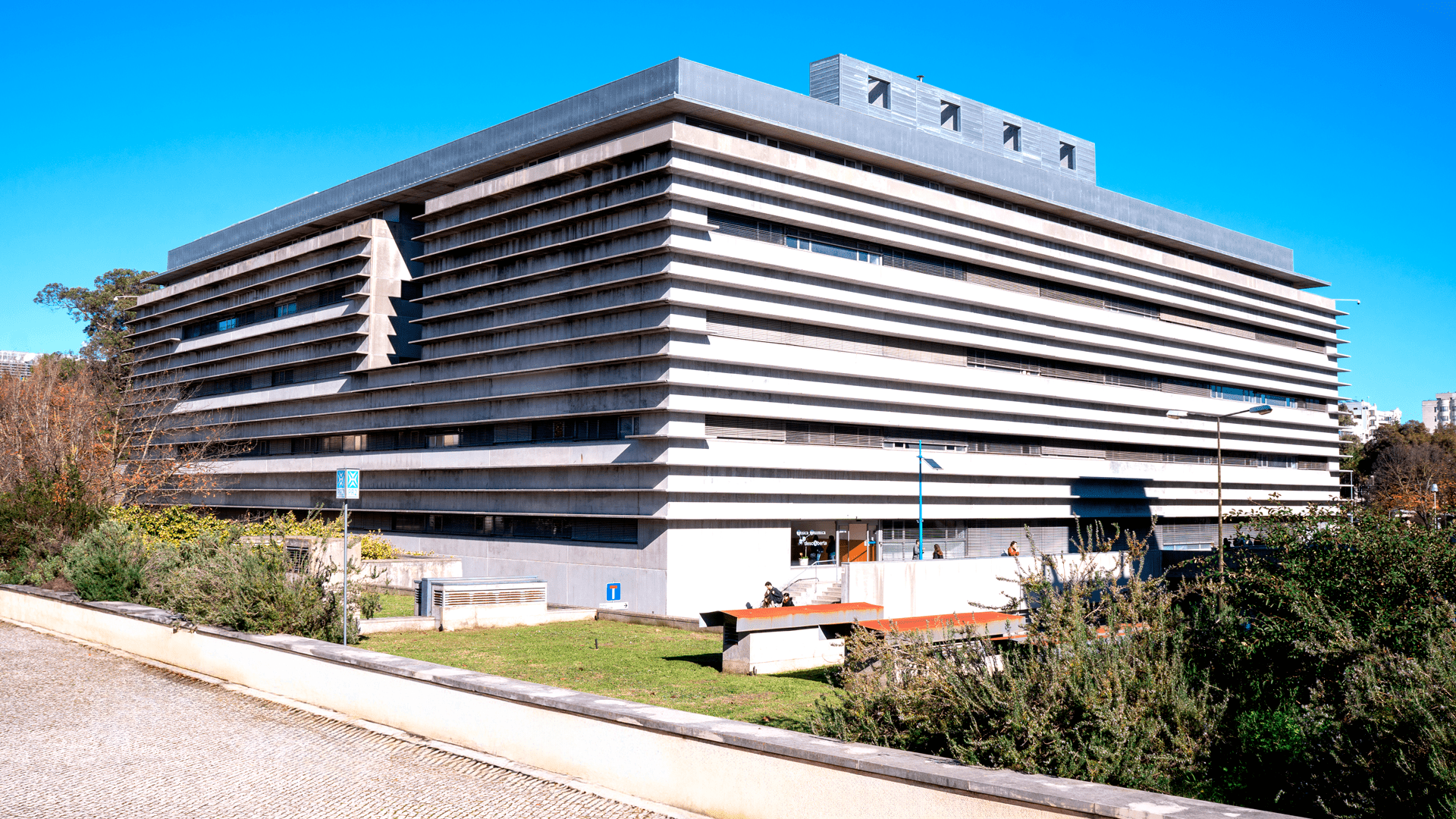
Founded in 1911, the Faculty of Sciences of the University of Lisbon (CIÊNCIAS ULisboa) is today a European benchmark in teaching and scientific research, with over 6,000 students, 650 professors and researchers, and 13 research centers equipped with state-of-the-art laboratories and scientific equipment. The past includes several major names in national science, but it is in the present that CIÊNCIAS makes a difference through international recognition and a 98% employability rate, which allows us to foresee a future marked by this Faculty.
The Campo Grande campus has 1.5 hectares of green spaces, easy access to roads and various public transport options in the vicinity, as well as proximity to the university stadium, the Campo Grande garden, and the largest hospital in the country.
Today, CIÊNCIAS goes beyond the city it bears in its name and has a field station in Serra de Grândola, a maritime laboratory in Cascais, and participates in the Lousal Museum. Within the city, it is actively involved in the Museu Nacional de História Natural e Ciência (Natural History and Science Museum) and the Observatório Astronómico de Lisboa (Lisbon Astronomical Observatory), as well as contributing to the foundation of the Lispolis business park. The Tec Labs incubator, which has paved the way for some of the most daring business ideas in recent years, currently operates on the current campus.
It was in 1985 that CIÊNCIAS opened its doors at its current location in Campo Grande. Before this major change, it was located in the vicinity of Príncipe Real - specifically on Rua da Escola Politécnica (1837-1911), which owes its name to one of the predecessor institutions of the current Faculty. Historical records also identify the Noviciado da Cotovia (1619-1759) and the Real Colégio dos Nobres (1761-1837) as institutions dedicated to technical and scientific education that preceded the founding of CIÊNCIAS.
In this long history, it is worth highlighting the relationship with the historic University of Lisbon, which was founded in 1290 and would contribute to the scientific and technological epic that accompanied the Discoveries. The motto followed today by CIÊNCIAS comes from that era: