Autonomia 21 - Integration of young people with Trisomy 21 (T21) into the labour market

ods-10-4-8-5

ULisboa Sciences participates in the project of the Associação Pais 21 - Down Portugal, whose goal is to integrate young people with Trisomy 21 (T21) into the labour market.

The driving force behind this idea at the Faculty was Federico Herrera, professor at the Department of Chemistry and Biochemistry (DQB) and principal investigator at the Laboratory of Cellular Structure and Dynamics at the Institute of Biosystems and Integrative Sciences (BioISI).

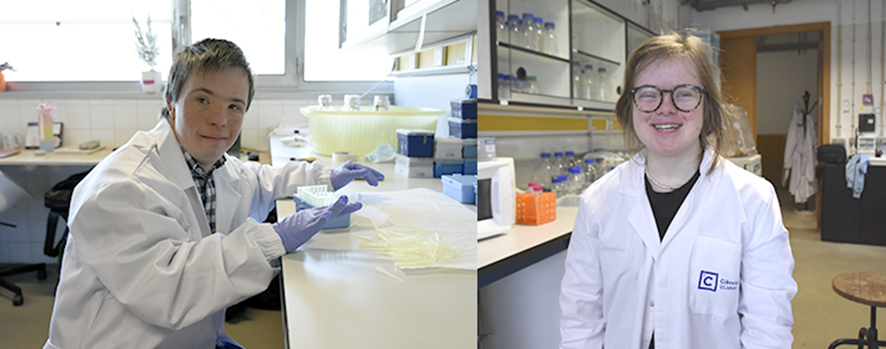
As part of this project, Ciências ULisboa welcomed two young people who are currently interning at one of the Faculty's laboratories.

Figure 1 - João Pedro Carvalho and Vera Souschek (Source: DCI Sciences ULisboa)

João Pedro Carvalho and Vera Souschek go to the BioISI laboratories on Thursdays and Fridays for a two-hour work period. Both are accompanied by a psychologist and a motor skills technician, and the adaptation work is done progressively and gradually, taking into account the needs and progress of each individual.

Both perform laboratory assistant work, with their main task being to prepare materials for sterilisation by filling boxes with micropipette tips. Andreia Barreto, a PhD student in Biochemistry, emphasises the importance of Vera's work: ‘She is doing a task that we had to do, because we need the tips to work all the time, which used to take up a lot of our time, so it's very useful work for us.’

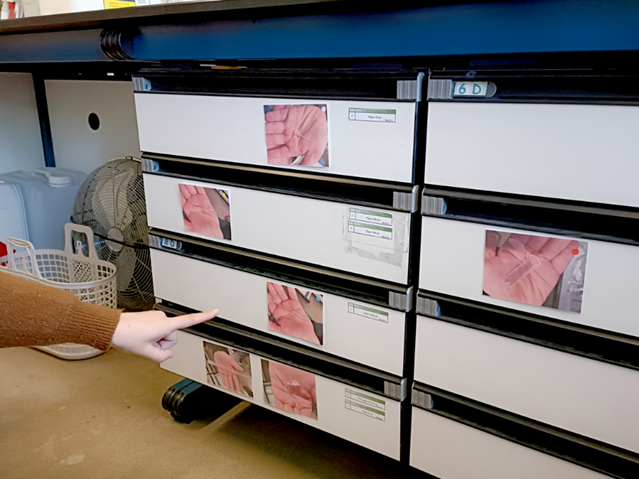
Figure 2 - Colour-coded pipette identification system to facilitate recognition of the various sizes and shapes of materials. (Source: DCI Ciências ULisboa)

Rita Avelino, treasurer of Associação Pais 21 and mother of a young person with T21, explains that people with this condition tend to be very meticulous and find it very easy to perform these types of tasks, which are simpler but very repetitive, without this bothering or distracting them. However, with proper support and encouragement, people with T21 have the ability to progress and vary the tasks they perform.

Rita Avelino also points out that this is a project with countless benefits, both for people with T21 and for society in general. The work experience gives young people more autonomy and confidence, as well as developing their social skills. For society, living with these people is very rewarding as it gives them a different perspective on intellectual disability.

Federico Herrera states that ‘the project is working very well and has great potential for the future.’ For the researcher, this experience could easily be extended to other laboratories at the Faculty, as the tasks performed by João Pedro and Vera are common to several departments and research centres.

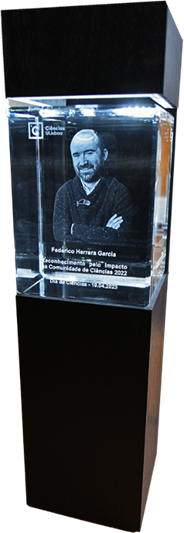
Figure 3 - Trophy awarded to Federico Herrera on Science Day (Source: DCI Ciências ULisboa)

As a researcher and trainer, the professor says that his job is to train scientists – “in this case, we continue to do exactly the same thing, but now also with people with trisomy 21, broadening the spectrum of people we are training a little,” he says. As a core element of life in society, work is synonymous with integration, he explains. In this sense, “the idea is to use work as a place of integration, for people with and without disabilities. The laboratory is not just a place to do science, the laboratory is a place of training and integration with a lot of potential”.

Manuela Pereira, professor at DQB and principal investigator at the BioISI Bioenergetics Laboratory, who is also involved in the project, emphasises the importance of Vera's work: ‘A person with Vera's profile could easily be an excellent laboratory technician in various biochemistry laboratories – it's a symbiosis!’

The “Autonomia 21” project, initially embraced by Federico Herrera and later also by Manuela Pereira, allows Ciências ULisboa to act in the pillar of social sustainability, marking a milestone in the relationship between academia and society. It was in this sense that, on 19 April, during Science Day, Professor Federico Herrera was recognised for his impact on the ULisboa Science community.

More information about this project:

Coordinator: Federico Herrera

Project members (FCUL internal): Manuela Pereira and students from the Cellular Structure and Dynamics Laboratory and the Bioenergetics Laboratory

Project members (external to FCUL): Vera Souschek, João Pedro Carvalho, Marcelina Souschek, Rita Avelino, Margarida Cunha and Patricia de Sousa

For more information, please contact sustentabilidade@ciencias.ulisboa.pt.

Announcements

Bem-vindo ao novo site da CIÊNCIAS ULisboa! EN