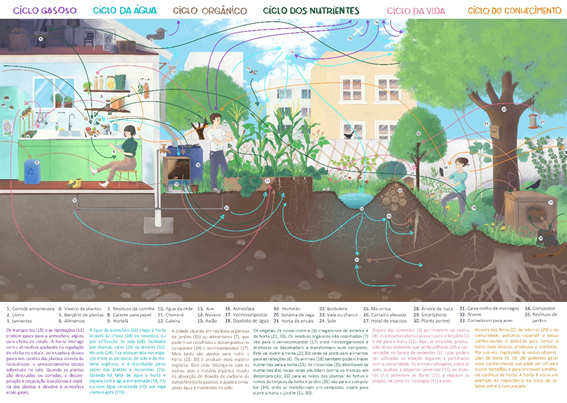
Water Cycle - Water from the atmosphere reaches PermaLab through rain or fog, or by infiltration into the soil, facilitated by puddles, ditches or trees. In the soil, it is stored in the free spaces between soil particles and organic matter, and is distributed by plant roots and mycorrhizae. When there is a lack of water, the vegetable garden is watered with the water stored in containers or with piped water, in this case, through drip irrigation.
Cycle of Life - After the seeds germinate in the nursery, the small plants move on to the PermaLab gardens. Once grown, they will produce new seeds that will be harvested and stored in the seed bank. These can be used in the following season and shared with the community. Wild animals help disperse seeds, insects pollinate flowers and regulate pests, as do bats and birds.
Nutrient Cycle - The uncooked organic waste is very rich in macro and micronutrients and is therefore channelled into the PermaLab vermicompostors where micro-organisms and earthworms break it down and transform it into compost. This will nourish the garden where food is produced. Animals can also bring nutrients to the garden. Mycorrhizae installed in undisturbed soil distribute nutrients from places where they abound with compost or decaying logs to the roots of the plants.
Organic Cycle - The campus abounds in organic garden or food waste which is collected and decomposed in the compost and vermicomposting facility. They are later used to nourish the campus gardens and produce more organic matter. This cycle interconnects with the others, as organic matter results from the absorption of carbon dioxide from the atmosphere and helps store water and nutrients.
Knowledge Cycle - Through books, the internet, the community that gets involved, facilitated trainings and scientific experiments carried out in PermaLab, we share and expand our knowledge and try to apply it to make PermaLab more diverse, productive and resilient. In turn, by recording our observations, we generate new knowledge and promote the continuous improvement of the space and of other spaces and projects of the collaborative network. PermaLab aims to be a place and an example of the importance of knowledge exchange among the community.
The demonstration and innovation potential of this initiative, and the technical-scientific follow-up to it, is disseminated scientifically, as in the case of the publication of a study led by a PhD student of Science, which aimed to grow a commercial hybrid variety and an open-pollinated variety of maize, exclusively based on compost from municipal waste and green waste as nutrient sources, and subsequently to measure the yield and mineral nutrition as a contribution to sustainable urban agriculture.
Coordinators: David Avelar e Florian Ulm
Permalab links:
References about the project:
For further information, contact sustentabilidade@ciencias.ulisboa.pt.